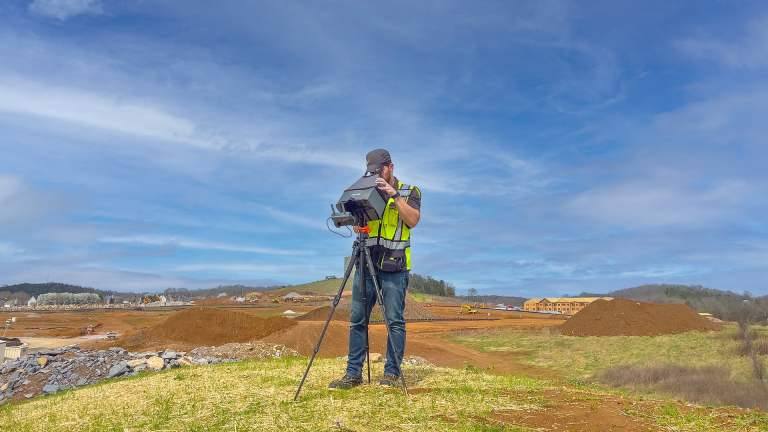


Commercial drone services. Let’s simplify this.
Most owners and developers don’t actually struggle with whether drones are valuable. In 2026, that debate is over. The real question we hear is this:
“Should we build this in-house or just hire someone who already does it well?”
That question isn’t about drones.
It’s about focus, risk, and leverage.
And when we talk about commercial drone services, those three things matter more than the aircraft itself.
First Principles: What Are Commercial Drone Services Really For?
Strip away the buzzwords and hardware specs.
Commercial drone services exist to do three things well:
- Capture reality faster
- Reduce risk on site
- Turn visuals into decisions
In construction terms, that usually means progress tracking, topo and site logistics, volumetrics, inspections, and stakeholder reporting, as documented by UAV Coach. When done right, drones compress timelines and reduce blind spots. When done poorly, they become expensive toys.
So the decision isn’t in-house vs. outsourced.
The decision is ownership vs. responsibility.
Why Many Companies Outsource Commercial Drone Services
Let’s start with outsourcing, because this is where most owners and developers land first.
1. You’re Buying Outcomes, Not Equipment
When you outsource commercial drone services, you’re not paying just for a drone. You’re paying for:
- An FAA Part 107 certified pilot
- A compliant operation
- A repeatable capture workflow
- Clean, usable data
The drone is the least expensive part of the equation. The real cost lives in training, compliance, insurance, data processing, and quality control.
Outsourcing lets you skip the learning curve and go straight to results.
2. Compliance Is a Hidden Tax
In the U.S., FAA Part 107 is just the baseline. Operations near people, active sites, or controlled airspace introduce real constraints. Add in insurance, safety plans, and site coordination and suddenly “just flying a drone” becomes a program, as stated by ConsortIQ.
Outsourced providers live in this world every day. That’s their edge.
3. Scalability Without Headcount
Projects ramp up. Projects wind down. Portfolios shift.
Outsourced commercial drone services scale with your workload. No rehiring. No retraining. No idle equipment sitting in a Pelican case.
For owners and developers managing multiple assets or geographies, this flexibility matters.
Why Some Companies Bring Drone Programs In-House
Now let’s be fair, because in-house can absolutely make sense.
1. Drones Are Mission-Critical to Daily Ops
If drone data drives daily decisions—earthwork quantities, schedule validation, or real-time site logistics—then owning that capability can be strategic.
Speed matters. Control matters.
2. You Want Tight Integration With Internal Systems
Some organizations want drone data fully embedded into their VDC stack, BIM workflows, or internal dashboards. In-house teams can customize capture standards and data pipelines to match internal processes exactly.
That level of alignment is hard to outsource.
3. Long-Term Volume Can Justify the Cost
If usage is frequent and consistent, the math can work, according to Commercial UAV News. But here’s the part people underestimate:
You’re not hiring a pilot.
You’re maintaining a program.
That includes turnover risk, retraining, equipment refresh cycles, and evolving regulations.
The Reality Most Teams Discover: Hybrid Models
Here’s what’s actually happening across the industry.
According to Arch Aerial Drone Services, a growing number of companies are running hybrid models. Here’s how it often looks:
- Internal teams handle routine progress flights
- Specialized commercial drone service providers step in for complex sites, high-accuracy mapping, or regulatory edge cases
This isn’t indecision. It’s maturity.
Hybrid models let teams stay nimble while avoiding overextension.
Common Challenges with Commercial Drone Services (No Matter the Model)
Let’s call these out plainly:
- Consistency: Data is only useful if it’s captured the same way every time
- Interpretation: Images don’t create insight. People do
- Technology churn: Hardware and software evolve fast
- Risk exposure: Safety, insurance, and compliance never stop
These challenges exist whether drones are internal or outsourced. The difference is who owns the burden.
So What Should Owners & Developers Do?
Ask better questions.
Not:
- “Should we buy drones?”
But:
- “How often will this data change decisions?”
- “Who owns compliance risk?”
- “What happens if this person leaves?”
- “Are we building capability or distraction?”
Commercial drone services are a means, not a strategy.
The smartest teams choose the model that protects focus, reduces risk, and delivers clarity…not just data.
Final Thought
Technology doesn’t create advantage. Decision-making does.
Whether you outsource, insource, or hybridize your commercial drone services, the goal is the same: clearer visibility, fewer surprises, and better outcomes.
If you want to explore how reality capture fits into a broader construction intelligence strategy, start a brief conversation with our team of experts.
No pitch. Just perspective.